We have been about to talk to dolphins for seventy years.
This page is a ledger, not an argument. It lists what was achieved, and how each
effort ended. You will reach your own conclusion before the bottom of the page.
A public research recordLast revised 3 September 2026Every claim carries its sourcing state
In December 1967, an acoustic engineer named Dwight Wayne Batteau delivered a final report
to the U.S. Naval Ordnance Test Station. In it, two bottlenose dolphins named Maui and Puka
responded correctly to thirty-five spoken commands, translated in real time into whistles.
One reproduced four trained whistle contours following a repeat cue.
The last paragraph describes what the team intended to do next: extend the vocal channel
and make the human a responding participant. We have not located a public record showing that
the full controlled experiment was completed.
What follows is every major attempt since, what each one demonstrated, and — the column
that matters — how each one ended.
01 — The documentWhat 1967 actually achieved
Contract N00123-67-C-1103. Eighty-eight pages. Read in full.
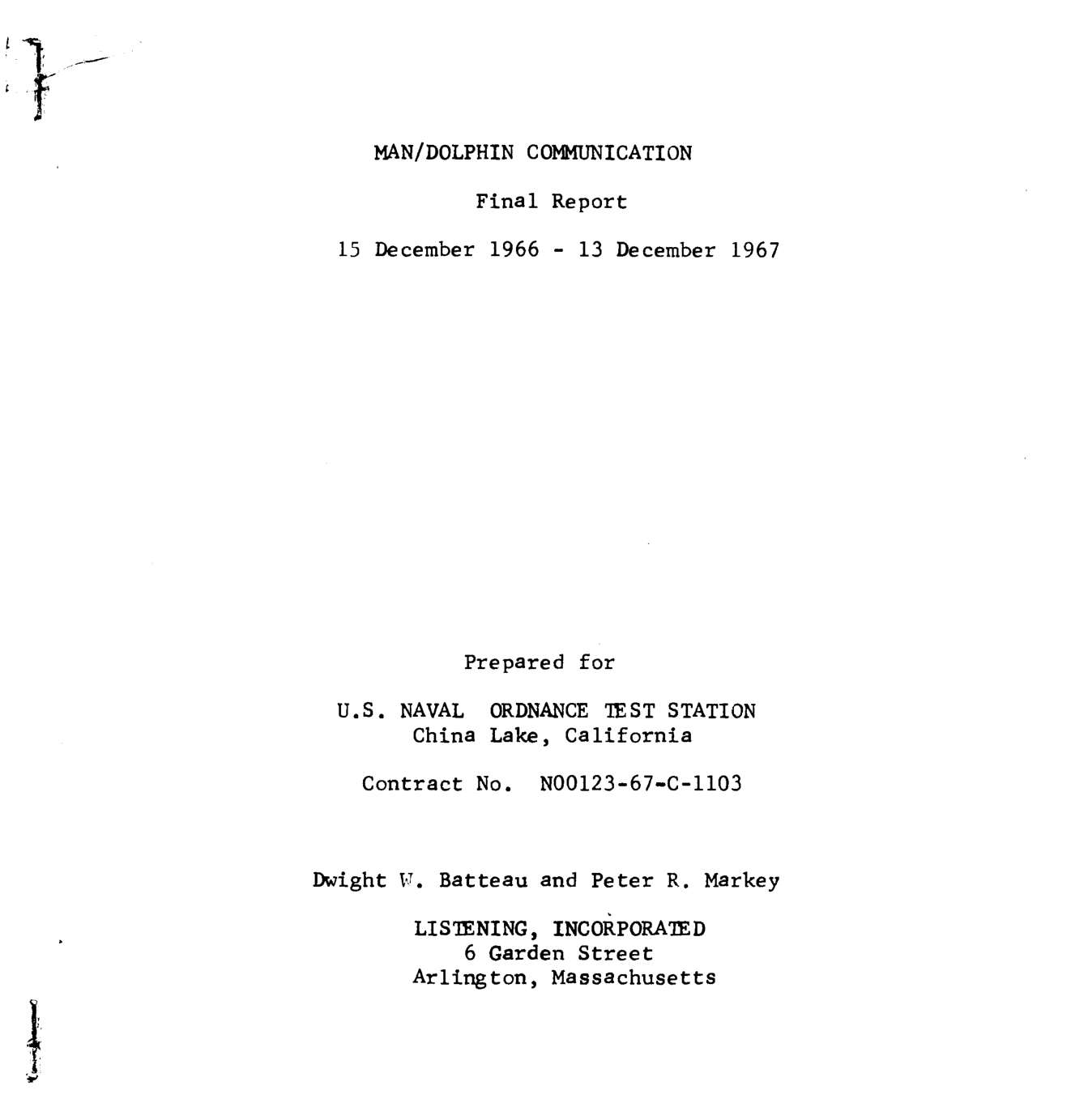
The title page. Batteau, D. W. & Markey, P. R., Man/Dolphin Communication —
Final Report, 15 December 1966 – 13 December 1967. Prepared for the U.S. Naval Ordnance
Test Station, China Lake, California, under Contract No. N00123-67-C-1103. Listening,
Incorporated, 6 Garden Street, Arlington, Massachusetts.
U.S. Navy contract technical report · public domain · full text reproduced below
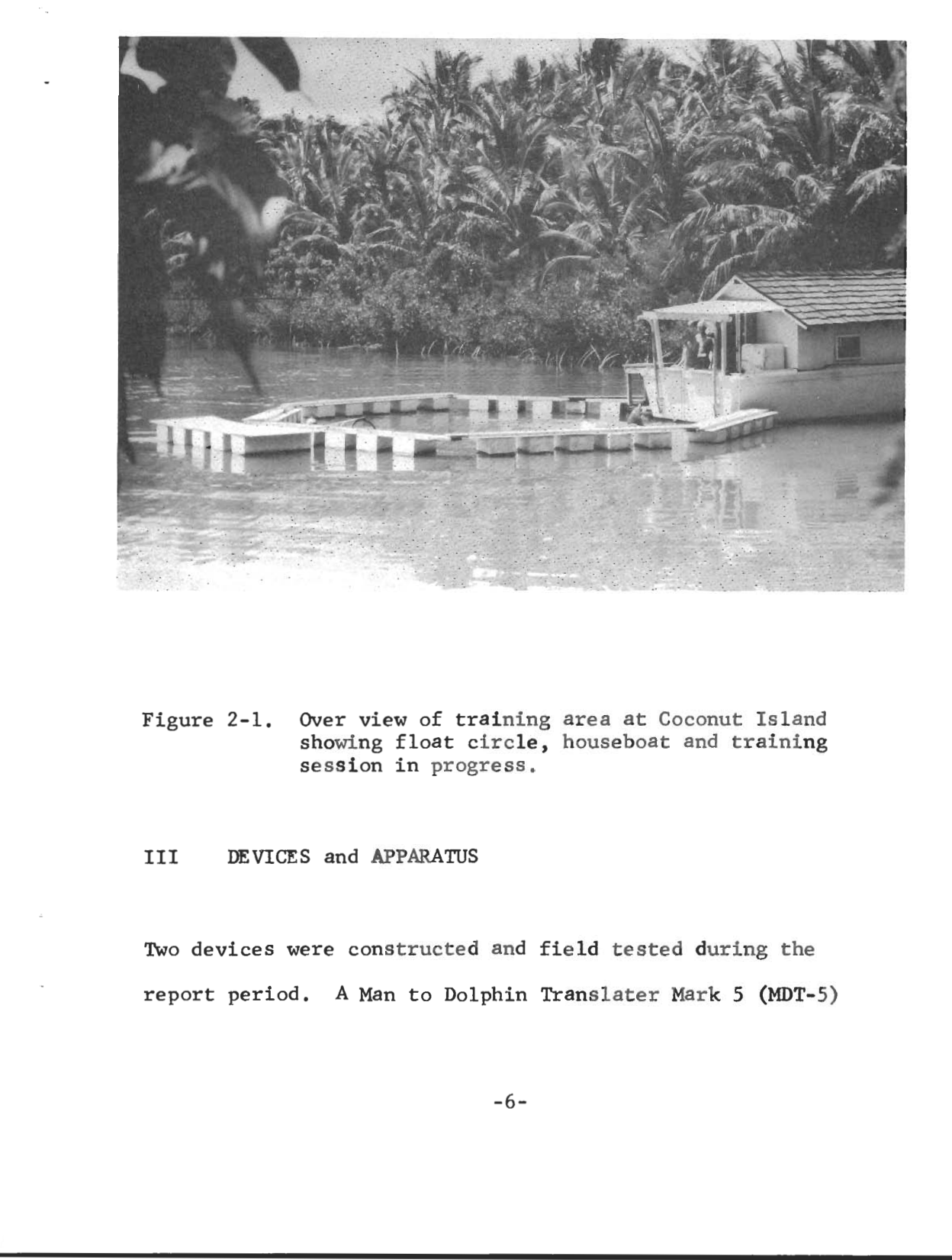
The work ran at a lagoon on Coconut Island in Kāneʻohe Bay, Oahu. A houseboat held the
equipment. A ring of floats defined the working area. Two dolphins, a male and a female,
worked with trainers who spoke English into a microphone; a device called the Man-to-Dolphin
Translator Mark 5 converted the vowel sequences into frequency-modulated whistles and put
them into the water through a hydrophone.
Figure 2-1, page 6. “Over view of training area at Coconut Island showing float
circle, houseboat and training session in progress.”
Photograph from the report itself · public domain
The vocabulary
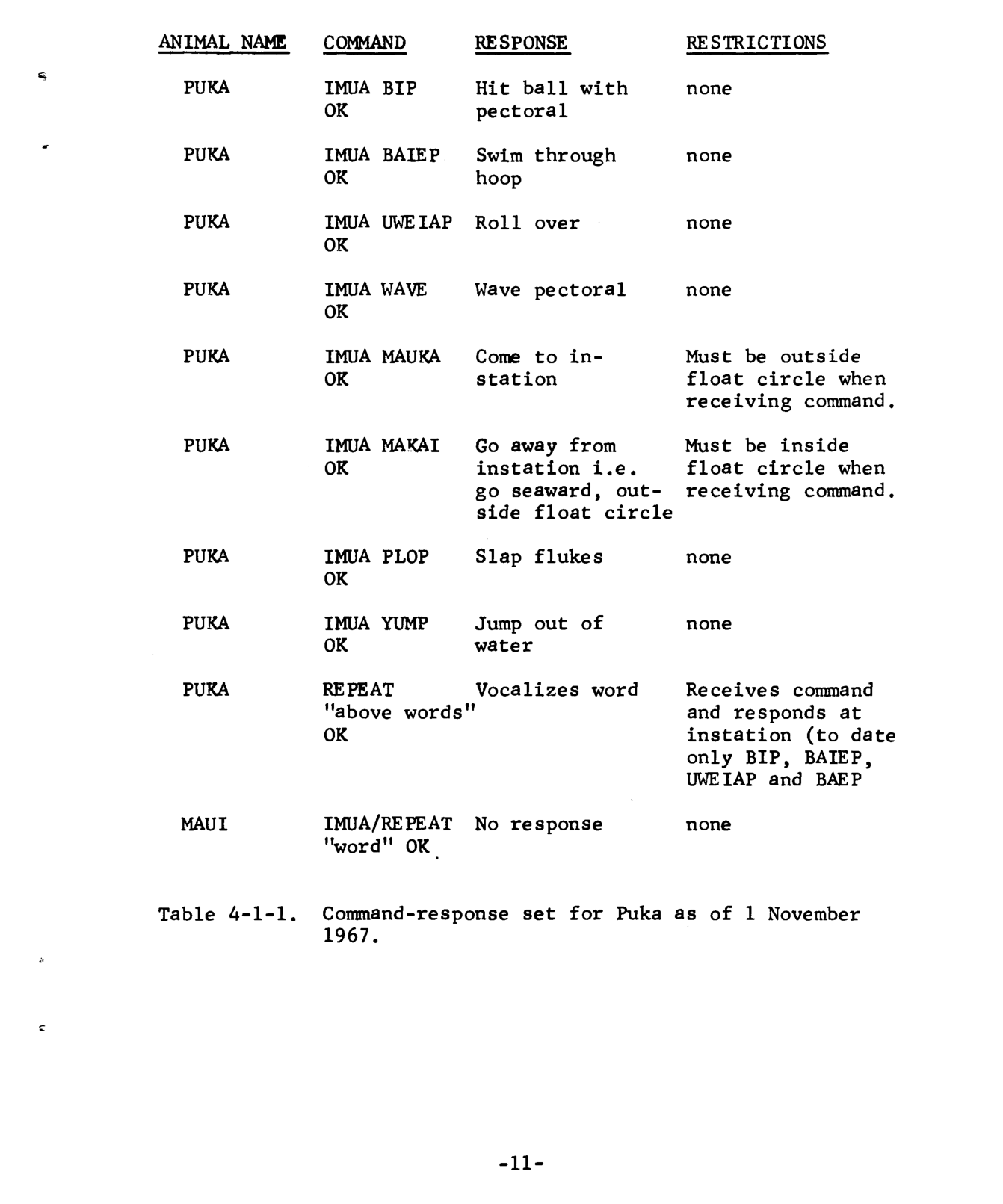
Thirty-five command strings were in use by 1 November 1967. They were not isolated cues.
Every command took the same four-part frame — NAME ·
IMUA · WORD · OK — an addressee, an imperative marker, the content word,
and a terminator. The animals honoured the addressee slot: a command aimed at Maui did not
move Puka.
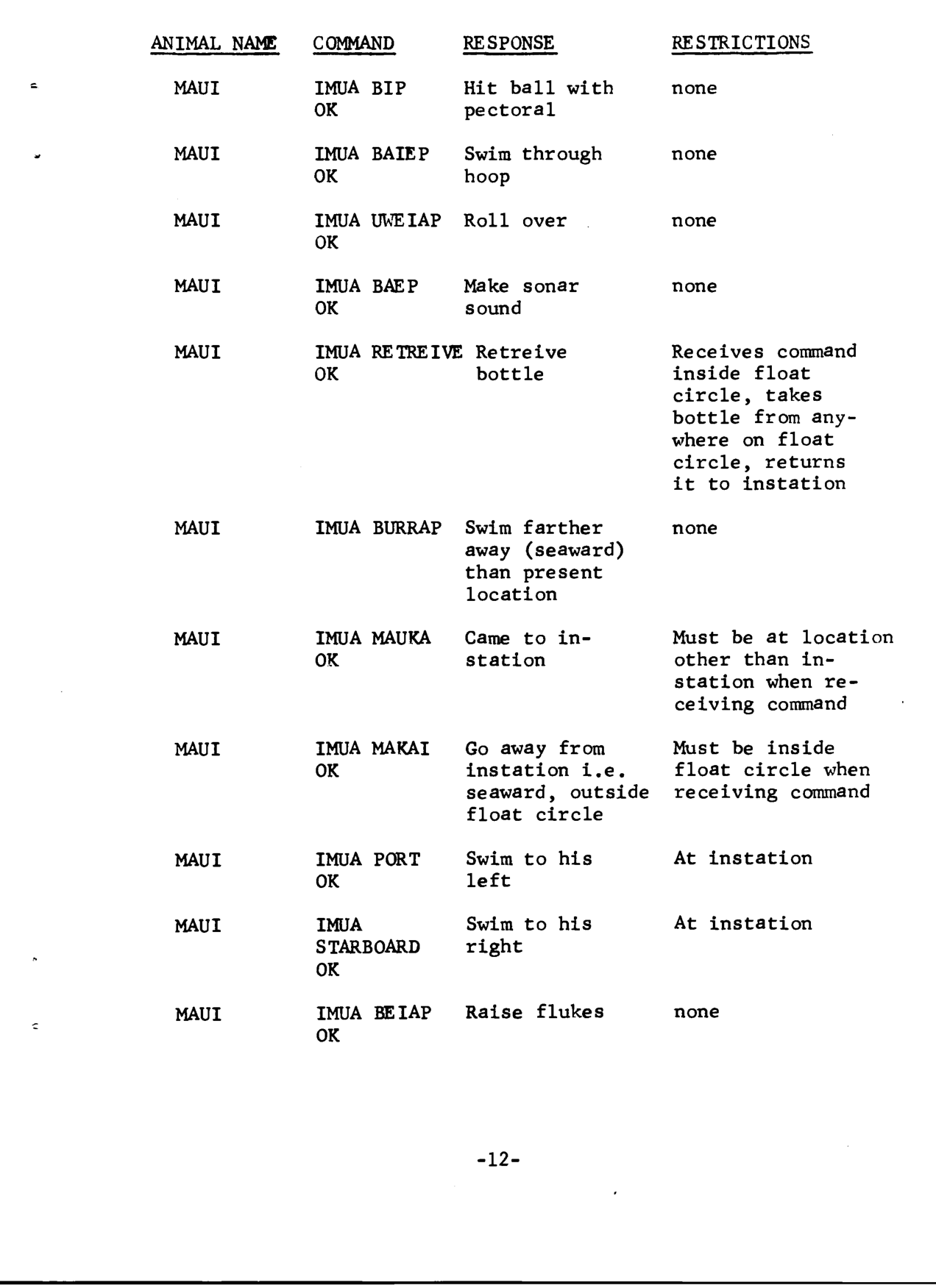
Command set for Maui, as of 1 November 1967
Command
Response
BIP
Hit ball with pectoral
BAIEP
Swim through hoop
UWEIAP
Roll over
BEIAP
Raise flukes
BAEP
Make sonar sound — a vocal response
RETRIEVE
Retrieve bottle from anywhere on the float circle, return it to station
BURRAP
Swim farther seaward than present location
MAUKA
Come to instation
MAKAI
Go seaward, outside the float circle
PORT
Swim to his left
STARBOARD
Swim to his right
REPEAT
Vocalizes the word — the dolphin says it back
Puka’s set also included WAVE (wave pectoral),
PLOP (slap flukes) and
YUMP (jump out of water).
The team did not simply report that the animals obeyed. They ran controls, and several of
them are the controls a linguist would ask for.
Speaker independence. In May 1967 two different
trainers using two different translators addressed both animals in the same session and got
correct responses — “a degree of independence of the character of the speaker’s
voice necessary to a general linguistic system.”
Place independence. In September, Maui responded
correctly to three commands while stationed seventy-five yards from the
transmitting hydrophone, and from randomly chosen starting points. Location of reception was
shown to be irrelevant to the response.
Minimal pairs. Truncated commands differing only
in frequency contour — BAI,
BEI,
UWE — were all discriminated correctly.
Production. Under the REPEAT
command, a dolphin vocalised the word back. Four words, as of that November.
And what they did not establish — in their own words
This report is not a promotional document. It fences its own results harder than most
modern press releases do.
Command sequencing failed: given two commands in a row, “the second behavior
associated word released the first behavior.” When the hoop and ball
were swapped, performance inverted — the team concluded the animals had been conditioned
“to associate a command word with a location rather than an object.”
And on the vocal channel, the sentence that governs everything:
“Attention was paid specifically to gross body motions since it was felt that
the vocalizations were not, at that time, under adequate control.”
When Puka correctly performed two behaviours she had never been taught, moments after
watching Maui perform them, the authors declared their own most exciting result
inconclusive.
The part that is almost never quoted
In the last quarter of 1967, the team inverted the loop. The dolphins were allowed to start
or extend a session themselves by offering a behaviour the trainer had not asked for. The
report describes this as establishing “a command-response point in a set assigned to the
trainer” — and says plainly what it meant:
“This rule permitted the dolphin to test the responding mechanism, the trainer.”
Man/Dolphin Communication, final report, page 83
A dolphin-initiated channel was running in a Hawaiian lagoon in 1967. It was restricted to
body movement rather than sound — for the stated reason that the vocal channel was not yet
reliable enough to use.
02 — The last paragraphThe next experiment named in the report
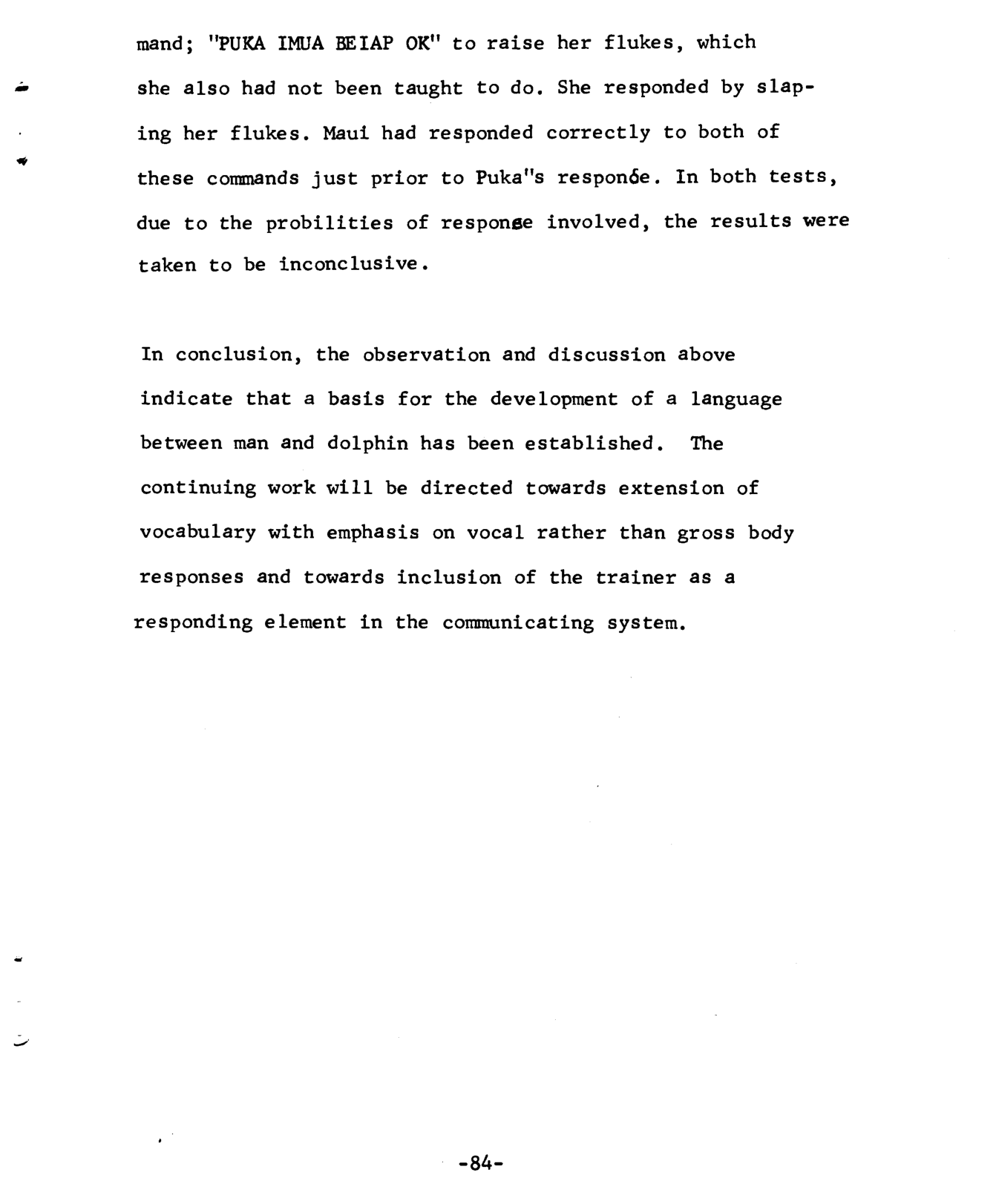
Page 84. The closing paragraph of the discussion.
Report page 84 · public domain
“In conclusion, the observation and discussion above indicate that a basis for the
development of a language between man and dolphin has been established. The continuing work
will be directed towards extension of vocabulary with emphasis on vocal rather than
gross body responses and towards inclusion of the trainer as a responding
element in the communicating system.”
Man/Dolphin Communication, final report, page 84
Read the second half of that sentence again. It is not a proposal to teach a dolphin more
words. It is a proposal to build a system in which the human answers — where
the animal is not a subject responding to commands but a participant in an exchange.
That is the proposed next experiment. The report shows that equipment and trained animals
existed. We have not yet established whether the same funding continued or whether a later
public or unpublished project completed the proposed work.
Dwight Wayne Batteau drowned on 26 October 1967, during his regular morning swim.
Reported death date — sourcing pending, see the note at the foot of this page
It was the day the two dolphins were to be moved from Coconut Island to the Oceanic
Institute. The report confirms the move: “On 1 November 1967, both animals were
placed in a newly constructed training tank at Oceanic Institute.” Six days later.
The report was carried to completion by Peter Markey and delivered that December. The
sentence describing the next experiment was published in a document finalised after its lead
author was dead.
One thing this page will not say
It would be easy, and wrong, to write that the Navy shut this down. The Navy
funded it — across at least four separate contracts, including a parallel
contract that paid for the facility, the animal transport, the veterinary support and the
food fish. A newly constructed tank was waiting for the animals.
The documents located so far show plans for continued work and the animals moving to a new
tank. They do not yet establish what happened to the research branch after the final report.
Batteau’s death is a documented lead in that history, not a verified sole cause.
03 — The ledgerSeventy years, and how each effort ended
The left column is what was achieved. The right column is why it stopped. Read the right
column.
1961
John Lilly, Man and Dolphin
The book that created the field and the field’s reputational problem in a single
volume. Lilly predicted interspecies conversation within a decade; his later work
discredited much of what surrounded it.
Documented event / branch status
Lilly’s later work became controversial. The effect on subsequent funding and the end
point of this research branch have not been established in this audit.
Branch continuation unanswered
1964 –67
Batteau & Markey — the acoustic translatorPrimary source
Three consecutive U.S. Navy contracts. Thirty-five commands on a four-part syntactic
frame. Speaker independence, place independence at 75 yards, minimal-pair discrimination,
elicited reproduction of four trained whistle contours, and a dolphin-initiated
body-movement channel.
Documented event / branch status
The final report named continued work, and the animals moved to a new tank. Whether the
branch continued, and why it ultimately stopped, remain unresolved.
Unresolved
1970s –2000s
Louis Herman — Kewalo Basin Marine Mammal LaboratoryConfirmed
The most rigorous artificial-language work ever done with dolphins. Akeakamai and
Phoenix demonstrated comprehension of word order, novel sentences, and reference to
absent objects — receptive language, tested to a standard the field still cites.
Documented event / branch status
Akeakamai and Hiapo died in 2003 and 2004, and the laboratory closed in 2006.
These events do not establish why the artificial-language branch was not continued elsewhere.
Branch continuation unanswered
1985
Marine World Africa USA — the first underwater keyboardConfirmed
Diana Reiss’s keyboard programme: dolphins operated a submerged interface that
produced computer-generated whistles paired with objects and activities.
Documented event / branch status
The Redwood Shores facility closed and the park moved to Vallejo. Whether the keyboard
programme continued after the move, and why this branch stopped publishing, remain unresolved.
Branch continuation unanswered
1992 –2004
EPCOT, The Living Seas — Xitco, Gory & KuczajUnexplained
An underwater keyboard at a Disney park. Dolphins learned not only to respond to human
key activation but to activate keys themselves — sometimes moving toward
the associated object or location ahead of the human. Published 2001 and 2004.
Documented event / branch status
No termination result has been located. Later related publications and the
animals’ continued presence do not establish why the keyboard branch stopped publishing.
Unexplained
1993
Reiss & McCowan — spontaneous mimicryConfirmed
Dolphins spontaneously imitated computer-generated whistles and increasingly produced
artificial whistle facsimiles of their own accord — production without a command
prompting it.
Documented event / branch status
Reiss later worked at WCS Osborn Laboratories, the National Aquarium, and Hunter College.
This career history does not establish why the keyboard branch ceased or whether it continued elsewhere.
Branch continuation unanswered
2010s –now
CHAT and the Wild Dolphin ProjectConfirmed
A wearable underwater computer, worked with wild Atlantic spotted dolphins. Imitation
of computer-generated signals was observed, including delayed attempts. Functional
understanding of the artificial object labels was not demonstrated.
Documented event / branch status
Primary records verify continuation through the summer 2025 field season; 2026 activity has not been independently confirmed. Functional understanding of the artificial labels has not been demonstrated;
subject engagement and interface performance are both live explanations.
Ongoing
2024
The EPCOT dolphins are relocatedSourcing pending
After thirty-two years on site, the animals leave the park.
Documented event / branch status
The 2024 animal relocation occurred roughly twenty years after the last keyboard publication
identified in this review. It does not establish when or why the research branch ended.
Branch continuation unanswered
04 — The patternThe scientific question remained open
What the record separates
Event A death, relocation, facility closure, or career move may be documented.
Branch For seven historical branches, the reason research ceased or changed remains unanswered.
Current CHAT continuation is verified through summer 2025; a complete 2026 global census is not claimed.
The located record contains promising results, serious experimental limitations, and several
incomplete termination histories. It does not supply a final verdict on a shared acoustic
interface.
The next historical question is therefore narrower:
Which branches continued, which stopped, and what evidence explains the change?
These branches left useful methods and published results, but they did not all answer the
same question or reach the same evidentiary standard. The open task is to learn whether their
strongest components can be combined under modern controls.
05 — The componentsSeveral necessary components have been demonstrated. Separately.
The literature reports each component below with different subjects, methods, and levels of
support. We have not located one study that combines them under a single controlled protocol.
1967
Speaker independence
Different humans, different equipment, same understood command.
1967
A syntactic frame
Addressee, marker, content word, terminator — and an honoured addressee slot.
1967
Dolphin-initiated exchange
The animal offers; the human is the one who must respond.
1980s
Comprehension of word order
Novel sentences, reference to absent objects, receptive syntax.
1993
Spontaneous production
Artificial signals produced without being asked for.
1990s
Self-initiated interface use
Dolphins activating keys themselves, ahead of the human.
2000s
Signature whistles
Individually specific signals, copied by others — natural reference.
2020s
Real-time machine listening
Model-assisted analysis at a speed no 1967 apparatus could approach.
That is the whole argument, and it does not require anyone to have done anything wrong.
The pieces appeared across different programmes. The 1967 report proposed extending the
vocal channel while making the human a responding element; no located public record shows a
controlled completion of that combined design.
Twenty years ago, every component in that grid except the last one already existed.
The last one now exists too.
06 — The honest answerWhat we think is actually going on
It is worth saying clearly what we do not believe, because a page like this invites
the assumption.
We looked for evidence of suppression and did not find it. The working census names more than
four hundred institutions, while the population estimate of roughly three thousand dolphins
remains advocacy-sourced.Figures pending verification Our bounded
search identified one current two-way collaboration; it did not establish a complete global count.
You do not suppress three hundred and forty-five facilities in fifty-six countries.
Access to dolphins is only one requirement. A useful interface programme also needs animal
welfare oversight, longitudinal participation, communication researchers, engineers, funding,
and a protocol that separates learning from cueing. Our census suggests those elements are
rarely coordinated; it does not yet establish why.
Which is worse, and better, than a conspiracy
Worse, because nobody is accountable for neglect. There is no decision to overturn, no
memo to find, no one who can be asked to reverse themselves. A thing that never became
anyone’s job simply doesn’t get done, year after year, and no one is at fault.
Better, because suppression would have to be defeated. Neglect only has to be
answered. One institution deciding this is worth a year of someone’s time
would close a gap that has stood open since 1967.
07 — What we are askingA question, not an accusation
The reviewed literature reports relevant components, while a controlled combination has not
been located. Missing public evidence leaves several possibilities open:
The design may have been attempted without a discoverable publication; it may have been limited
by scientific, welfare, access, funding, or technical constraints; or it may not have been attempted.
Resolving that history and specifying a controlled modern protocol are separate tasks. Better
equipment reduces some engineering constraints but does not settle the scientific question.
We are not trying to prove that dolphins have language. We are trying to establish, with
enough historical resolution to design a defensible test, exactly how far this got and
exactly where it stopped. If you know of work that closes any branch on this page —
especially work that contradicts it — that is the most useful thing you could
send us.
Awaiting the trio panel
Institutional logos and mission-statement excerpts for the three organisations
that hold all three legs — engineer, facility and animals — in one place.